
On the Perversity of Personal Productivity
...or on the collapse of the work into the self.

You wake up. Before your feet touch the ground, a smartwatch tells you the sleep score. An app reminds you to meditate. A calendar notifies you to eat breakfast with a book.
It’s 9:00 a.m. You’ve already “won” the morning.
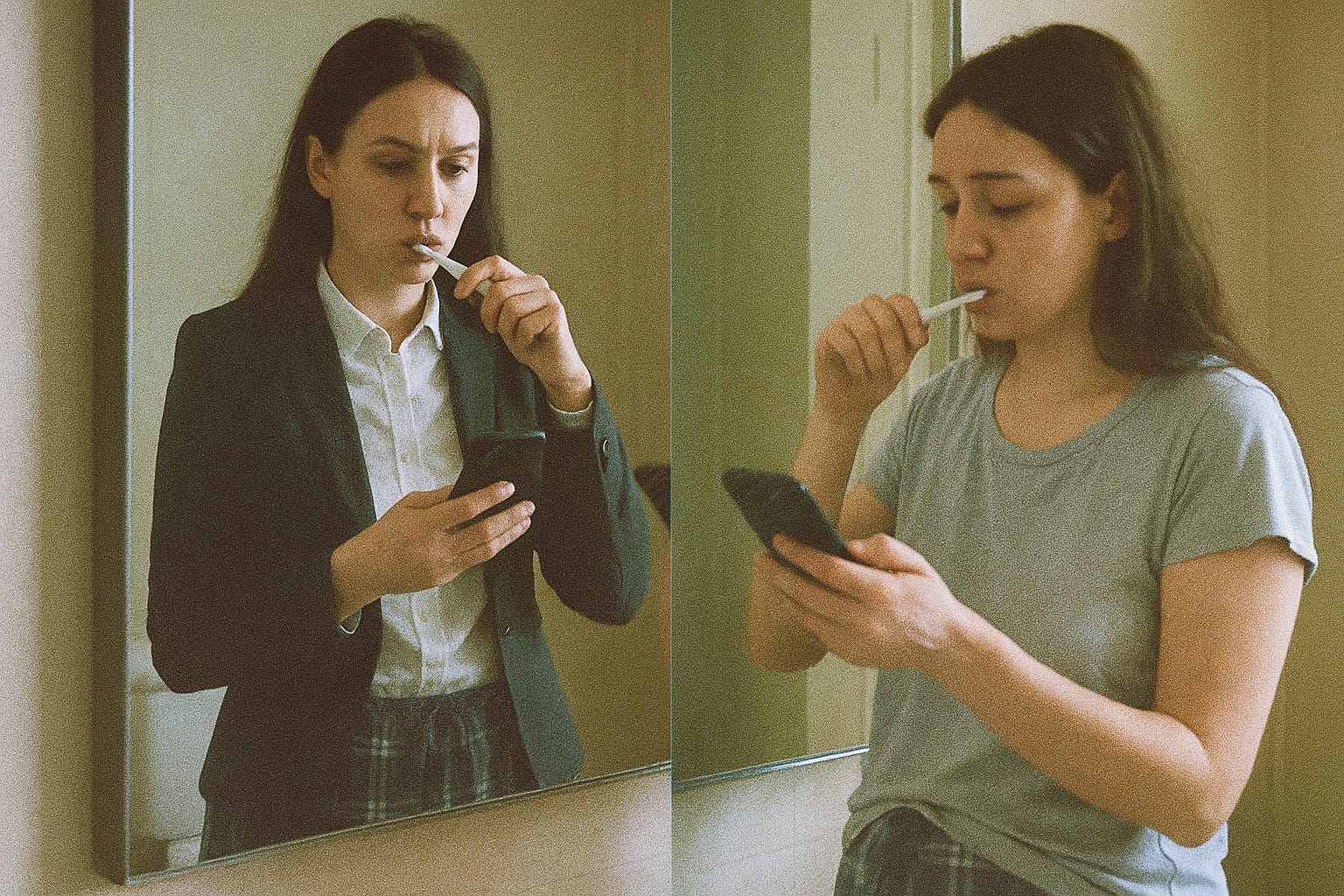
This is not a lifestyle. It’s a compulsion. A self-imposed tyranny in the name of “self-improvement.”
A perversion.
Not because it’s immoral or wrong to be productive, but because of how deeply the productivity penetrated our inner lives.
We train like athletes to “live healthier”, track our sleep to “recover smarter”, and turn hobbies into hustles for “financial freedom.”
We are working on ourselves every single moment.
It’s as if we’ve swallowed the logic of the workplace and applied it to our whole life.
The only value worth pursuing is the kind that can be tracked, quantified, and improved.
This is where the perversity lies.
We take our freedom and we force it to perform. We take our leisure and turn it into labor. And we call it liberation.
How Did Leisure Become Labor?
It used to be simple. Work was work. Leisure was leisure. There was a line. You clocked out, and your time was yours.
Now? Even vacations are scheduled like military campaigns.

Museum at 10, local market at 11, lunch at the five-star-review restaurant by noon. You’ve barely swallowed your appetizer before racing to the next “must-see.”
And god forbid you forget to post a perfectly curated photo as proof.
Joggers train like professionals. They obsess over personal records, recovery protocols, and VO2 max. Smart watches log every heartbeat and turn casual movement into measurable progress.
Even sleep has turned into an activity.
Track it. Grade it. Gamify it.
Take supplements. Avoid screens. Wear blue light glasses.
Wake up and check your sleep report.
So what changed?
Technology blurred the line between work and leisure. First email, then smart devices, and finally social media.
Now the office is everywhere. In the kitchen, on the trail, in the bed. And slowly, the logic of productivity (efficiency, measurement, and goal orientation) has spilled over the edges of work and seeped into our personal lives.
We are always on the clock and no longer need a boss to exploit us. We exploit ourselves in the name of self-improvement.
We are the boss, the worker, the product, and the consumer all at once.
And perversely, we like it.
Or at least, we’re addicted to it, because true leisure feels wrong, wasteful, and empty.
Sitting in a park with no phone, no book, and no podcast? It doesn’t feel like rest. It feels like failure.
That discomfort is the giveaway. We’ve internalized the rules of productivity so deeply that we can no longer experience rest as rest.
We must justify it, frame it, and turn it into a recovery protocol or creative reset.
It’s not: “I’m taking a walk.”
It’s: “Walking helps me clear my mind so I can perform better.”
What Are We Really Chasing?
Let’s ask a question: Are we truly chasing productivity or something else that lies beneath it?
No one optimizes their morning routine just to save time. No one tracks their hobbies, sleep, or orgasms just for the data. What we’re chasing isn’t efficiency. It’s a feeling. A sensation of control. Of purpose. Of finally being the person we think we’re supposed to be.
Jacques Lacan defined it as “objet petit a”. It’s not the thing you want; it’s the fantasy behind the thing.
Not the run, but the image of yourself as someone who runs. Not the vacation, but the fantasy of a life worth documenting. Not the optimized routine, but the imagined version of yourself that has finally figured it all out.
We chase these things not because we want them, but because we believe having them will make us whole.
And yet, no matter how many things we track, how many routines we perfect, how many metrics we master, wholeness never comes.
We hit the goal, and a new one appears. Productivity doesn’t close the gap. It is the gap.
But the fantasy persists.
“Once I organize my time better, I’ll feel calm. Once I run the marathon, I’ll feel confident. Once I travel to Mykonos, I’ll feel complete.”
But we never get there.
Because the object of desire keeps moving, like a mirage, always just a little further, just one life hack away.
You don’t chase productivity for its own sake. You chase the idealized version of yourself that it promises:
The one who finally has peace, purpose, and control.
But that person doesn’t exist.
And that’s the trap.
Who Taught Us to Want This?
Let’s not flatter ourselves. Our desires are not as personal as we’d like to believe.
We think that we just “like” optimizing things. That we’re naturally wired to self-improve. But desire is not spontaneous. As Lacan argued, “Desire is the desire of the Other.”
What does it mean?
It means we desire what we believe others expect us to desire. We want to be what the people around us want us to be.
And in a world dominated by curated feeds, quantified selves, and performance-as-identity, it’s very clear what that is:
A person who does it all. Efficiently. Effortlessly. Excellently.
We optimize not in a vacuum, but in a feedback loop. The runner doesn’t just run. She shares her route, her time, and her pace.
The traveler doesn’t just experience a city. He ranks, posts, and tags it.
The couple doesn’t just love. They share photos, communicate, and align their emotional goals.
It’s all on display, and so we internalize a standard that isn’t ours but feels personal.
It’s no longer Big Brother watching us. It’s us watching ourselves, through the eyes of everyone else.
And Social media feed on this, turning lifestyle into performance.
Self-help culture monetizes insecurity. Productivity influencers tell us how to live.
And we thank them for it.

Even “rest” must be documented to be real. You didn’t nap unless you posted about it with a quote from Seneca and a photo of coffee.
You are not just allowed to enjoy, you are expected to. But only in the right way.
The rest must be regenerative. Pleasure must be productive. Fun must have benefits.
It’s no longer enough to do something; you must justify it. And if you can’t, it doesn’t count.
This is how productivity becomes internalized as morality.
Not because someone makes us, but because we’ve come to believe it’s what a “good life” should look like.
The script is already written. We just copy-paste it into our calendars.
What If We’re Enjoying the Ritual, Not the Result?
But here’s the twist: maybe we’re not victims of productivity culture. Maybe we just enjoy it too much.
Not the results. Not the promises. But the structure. The rules. The rituals. The satisfaction of closing rings, crossing tasks, and logging reps.
A painful enjoyment. Like scratching an itch that never goes away.
In this sense, we’re not chasing rest. We’re chasing the structure of the chase itself.
We say we want freedom, but we cling to our calendar. We say we want leisure, but we organize it like a performance. We say we’re burned out, but we refuse to stop tracking, scheduling, and improving.
Why? Because that ritual, that system, has become the only way we know how to enjoy ourselves.
This is perversion, in the psychoanalytic sense. Not sexual kink, but the deeper twist where we start to enjoy through the rules that are meant to restrain us.
The constraint is the source of pleasure.
It’s not: “I rest because I want to.”
It’s: “I rest because it fits into my system, and my system makes me feel safe.”
And that’s the tragedy.
We don’t even trust ourselves to feel pleasure freely. We need the app to tell us. The data to confirm it. The system to validate it.
So we stay in the loop.
Not because we’re looking for peace, but because we’re looking for controlled satisfaction.
What’s the Way Out?
First, contain the spill.
Let productivity belong to your job, your calendar, your inbox. Shut the door when you step outside of work. Let the rest of your life be something else. Messy, unmeasured, unapologetically yours.
If you’re unsure, ask: “Is this meant to be efficient, or is it meant to be mine?”
Walk without tracking. Read without highlighting. Rest without calling it recovery.
Let some things be pointless. That’s freedom.
And when you sit quietly with nothing in your hands: No screen, no music, no podcast, feel the discomfort. Stay with it.
Your breath slows down. The body softens. Mind unclenches.
Your nervous system exhales.
You’re not failing. You’re existing.
Still. Present. Unpressured.
That’s leisure. Not strategic rest. Not optimization. Just existing without purpose.
And maybe, in that quiet moment, you remember what it feels like to be a person, not a project.
Oh boy. Some strand of fate led me here today. 'What we’re chasing isn’t efficiency. It’s a feeling. A sensation of control. Of purpose. Of finally being the person we think we’re supposed to be.' -- you've nailed it fella.
Seriously? The entire email sounds exactly like ChatGPT wrote the whole thing.